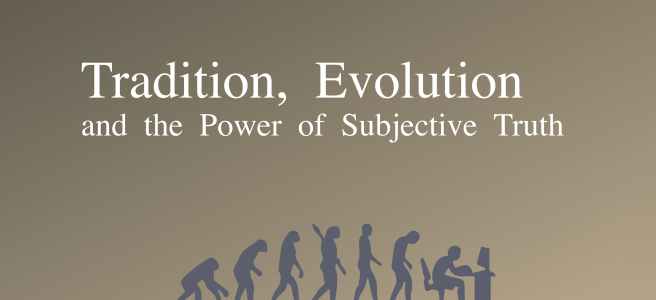
Our current culture has a tendency to ignore or toss aside our traditions, practices and/or beliefs handed down through many generations, as though they have no value and can be easily replaced. Why did our ancestors hold these traditions? And why did they hold these traditions for hundreds, if not thousands of years?
What I’d like to propose is that traditions are the epitome of quality, by virtue of their survival through a weeding out mechanism of great power: the evolutionary process.
Quality is Immeasurable
How does one understand if something is of good quality? Our left-brained dominated culture would have us measure it. However, what I have found from 20 years of creating complex software applications is that quality cannot be measured. Ask yourself: how do I measure the quality of a novel? How do I measure the quality of a movie? How do I measure the quality of a piece of music? What form of measurement would you use? What do you measure for each medium?
One cannot measure quality. What I see in the software industry are the use of proxy measurements: taking dozens of quantifiable data, weigh the data and aggregating them into a single number representing quality. However, this is an incredibly brittle way of measuring quality due to the fact that not all consumers are using your product or service for solving the exact same problem.
Evolution
How does one assess quality? The only way to assess is by trial and error over time. What does this look like? In my industry, this is called Agile. This is a philosophy of iterating small changes over time. With each change, the update is provided to the stack holders (clients) for review. Feedback is taken back to the engineers and designers to assess and create a new update path for the service/product. This happens many, many times over a period until all involved believe they have a minimum viable product (MVP) for a release.
This Agile philosophy is essentially the same concept as biological evolution. The big difference is that in software, code dies. In biology, plants and animals die. However, they all improve over time by applying stressors to a system and having the system adapt to the stressors.
Assessing quality can sometimes be the same as creating quality. I find this happening quite a bit as an engineer, in that when I’m told to assess if some new idea will work, I have no way of truly knowing if something will work, until I actually build it.
Traditions from Principles
Through many iterations over time, certain principles present themselves. In software, there are principles that are prevalent throughout the industry. These principles come out of decades of iterating quality into software. Object Oriented Principles and the SOLID Principles have become bedrock ideas to be followed throughout every corner of the software industry.
These qualitative ideas are principles, but over a longer period of time they would be categorized as traditions. Our ancestors have already iterated qualitative ideas over many hundreds/thousands of years and have embedded these ideas into traditions.
The reasons behind these traditions might not be readily available. Sometimes we just don’t understand why there’s a particular qualitative truth. For instance, through much trial and error, our ancestors came to the tradition of the Sabbath. They most likely had no clue why we needed a day off during the week from labor, either logically or biologically. However, through much trial and error over time they came to the understanding that we all needed a break. This is what I would call a subjective truth.
Subjective vs Objective Truth
What is truth? Most people today equate the word “truth” to objective facts. They use them interchangeably. But truth is more complex than that. Traditions are subjective truths. A subjective truth primarily deals quality, while objective truth deals with quantities.
An objective truth would be something like: the average height of human males. This is objective in that we can measure the height of men. It’s a calculation that’s not gonna change, no matter who performs the calculation.
A subject truth is something like the golden rule: Treat others as you would like others to treat you. This is something that is not measurable in any way, but has become a valued tradition in society because it has gone through the evolutionary process over hundreds of years and survived.
The Power of Traditions
Most things perish. In biological evolution, over 99% of all species have gone extinct. If something survives the evolutionary process over time, it should be deemed of high quality. If it wasn’t of high quality, it would have been replaced. From this perspective, traditions should be seen as something very special. Ignore them at your own peril. It’s ignorant and arrogant to believe that you are smarter and more enlightened than thousands of years of collective knowledge gleaned through the process of evolution.
Overview
Traditions are subjective truths that have survived the evolutionary process over hundreds of years. They are needed due to the fact that we cannot measure quality, but can only instill quality in principles, that over time become traditions, or markers of great quality.

 LongLoft - Code Writer