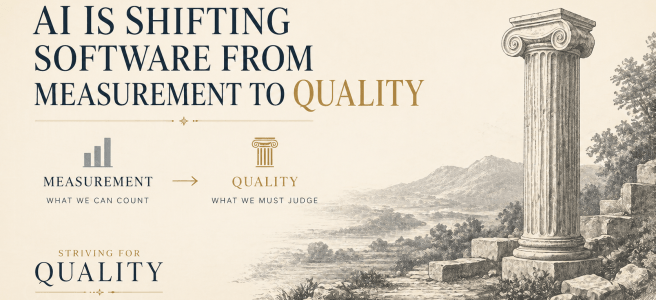
AI is shifting software from a world of measurement to a world of judgment. For decades, we built systems that optimized for consistency because it could be tested and measured. But AI produces qualitative outputs that cannot be fully asserted, forcing teams to reintroduce human evaluation and rethink testing itself.
Author: Jesse Daniels
Lost Beauty in Clothing: From Quality to Quantity
Why does modern clothing feel like it has lost its beauty? For most of history, clothing united appearance and function, where what looked right was usually right. Garments had to provide warmth, protection, and durability, and their aesthetics carried real meaning because they were grounded in quality. As modern systems removed the need for clothing to prove itself through use, beauty detached from provision and became easier to manufacture, scale, and discard. What followed was a shift from quality to quantity, where appearance no longer reliably reflects reality.
Why Narrow Responsibilities Make Better AI Agents
Better AI agents don’t do more. They do one thing well, within a clear hierarchy of responsibility.
Multiculturalism: Mixing Culture and Custom
A look at the difference between culture and customs and why confusing them leads to a misunderstanding of multiculturalism. Systems can sustain diversity in expression, but not division at the level of meaning.
Ageism: The Forgotten Justice Issue in Modern Society
Western culture has moved past some prejudices, but ageism remains. Scripture reminds us: the elderly still bear fruit and deserve honor.
Metabolic Debt: How Civilization Traded Starvation for Fragility
We are living in a civilization suffering from metabolic debt that is caused by a system violating subsidiarity in pursuit of a noble goal.
The Order of Truth: Why Subject Comes Before Object
How truth depends on the subject coming before the object — meaning before measurement.
How Admiration Sustains the World and Adoration Renews It
We often treat admiration and adoration as the same, but they are not. Admiration refines what exists through responsibility; adoration renews what is still becoming through love. When we confuse them, both relationships and systems begin to fracture. But when they are rightly ordered, love becomes whole, sustaining both structure and spirit across creation
Christian Nationalism, Secularism, and the Hierarchy of Responsibility
Why society works like a complex system—and how Catholic Social Teaching keeps its responsibilities in balance.
Why Patriotism Fades When Ownership Disappears
Catholic Social Teaching, psychology research, and complex systems all point to the same truth: love of country depends on widespread ownership and responsibility.