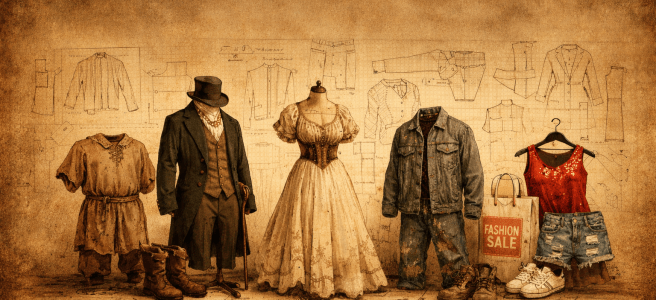
Walk into your closet and count how many pieces of clothing you own. Now ask a harder question: how many of those pieces are good?
Not good in the sense of style or trend, but good in the sense that they do what they are supposed to do, continue to do it over time, and fit into the rest of your life without friction. That question used to be much easier to answer, because for most of history, clothing could not separate what it looked like from what it did.
When Provision and Beauty Were One
Clothing was once a system of provision. Layers handled hygiene, insulation, and protection, and each piece depended on the others. If something failed, you felt it immediately. There was no buffer between the body and reality.
Because of that, clothing had to be made well. Materials mattered. Construction mattered. Fit mattered. And over time, something else emerged from that constraint.
The clothing began to look right.
You can see this in simple garments. A well-made wool coat held its shape, wore evenly, and continued to perform over time. A poorly made one sagged, broke down, and lost both function and form. The difference was visible because the quality was real.
The same was true for layering. A properly fitted linen shirt under a wool outer garment allowed the whole system to move and breathe as one. If the base layer failed, the system failed, and it showed.
Even among the English gentry, this connection held. A well-tailored coat was not just elegant. It held its structure, moved with the body, and endured repeated wear. The line of the garment reflected the quality of the material and the precision of the tailoring.
This is where Beauty enters, but not as decoration. Beauty was the visible expression of a system that was working. When something provided well, endured over time, and integrated properly with the rest, it produced a kind of Beauty that could be recognized immediately.
This is where Beauty enters, but not as decoration. In my book Striving for Quality, Beauty is not just what we like to look at. It is a judgment of quality within a system. What you see in clothing here is Beauty of Provision, where the appearance of something reflects what it can reliably provide.
Why That Connection Mattered
When Beauty is tied to Provision, it becomes reliable. You can trust what you see.
A well-made garment looks different because it is different. The materials, the construction, and the integration all show through. This allows people to judge quality quickly, without needing to test everything over long periods of time.
That creates stability. Systems where Beauty reflects Provision reinforce themselves, because good judgment leads to better outcomes, and better outcomes reinforce good judgment.
Over time, this alignment produces something even stronger. When something is both immediately pleasing and deeply functional, it approaches what is described in Striving for Quality as the Beauty of the Sacred, where provision and perception are fully integrated.
When the Connection Broke
That connection did not disappear because people stopped caring. It disappeared because it was no longer required.
Heating reduced the need for insulation. Hygiene systems reduced the role of base layers. Cheap production reduced the cost of failure. If something does not work well, you can replace it quickly, and the consequences are small.
Once clothing no longer had to prove itself through use, Beauty could separate from Provision. You could produce something that looked right without it being right.
At that point, a different kind of Beauty takes over. In Striving for Quality, this is Beauty of Consumption, where appearance is optimized for immediate judgment rather than long-term performance.
What Replaces It
When Beauty detaches from Provision, it does not disappear. It scales.
Because it is no longer tied to materials, craft, or time, it can be produced quickly and in large quantities. It becomes easier to change, easier to discard, and easier to optimize for attention.
This is why quantity begins to dominate. Beauty of Consumption can be generated immediately, while Beauty of Provision requires time, use, and discipline. Systems that optimize for speed and measurement naturally move toward the former.
Clothing becomes abundant, but the signal it carries becomes weaker. It looks like more, but it means less.
Why It Feels Like Something Is Missing
When people look at older clothing, or older buildings, or older objects, they often say that something has been lost. What they are noticing is not just decoration or style. It is the alignment between what something is and how it appears.
When that alignment is present, Beauty has weight. It reveals something real. When it is gone, Beauty becomes harder to trust. It is still there, but it no longer tells you much about the thing itself.
You can see this shift clearly in modern fine art. Once detached from craft, material discipline, and any requirement to endure or function, art is free to pursue expression alone. But without the grounding of Provision, Beauty becomes unstable. It can provoke, shock, or signal, but it no longer reliably points to underlying quality.
This is the difference between a system that is integrated and one that is not. In an integrated system, Provision and Consumption reinforce each other. In a disintegrated system, they separate.
Final Thought
Clothing changed when we gained the ability to separate appearance from reality. Once something could look right without being right, the system no longer required quality to persist. Under those conditions, it naturally moves toward what is easiest to produce, measure, and scale.
In the language of Striving for Quality, this is the movement from a system grounded in Beauty of Provision toward one dominated by Beauty of Consumption. What looks like a preference for quantity is actually something deeper. It is a shift toward disintegration, where appearance and provision no longer reinforce each other, but drift apart.
And when that happens, Beauty loses its grounding, quality becomes optional, and the system slowly comes apart.


